
International Criminal Defence Across Borders

Updated: Apr 22
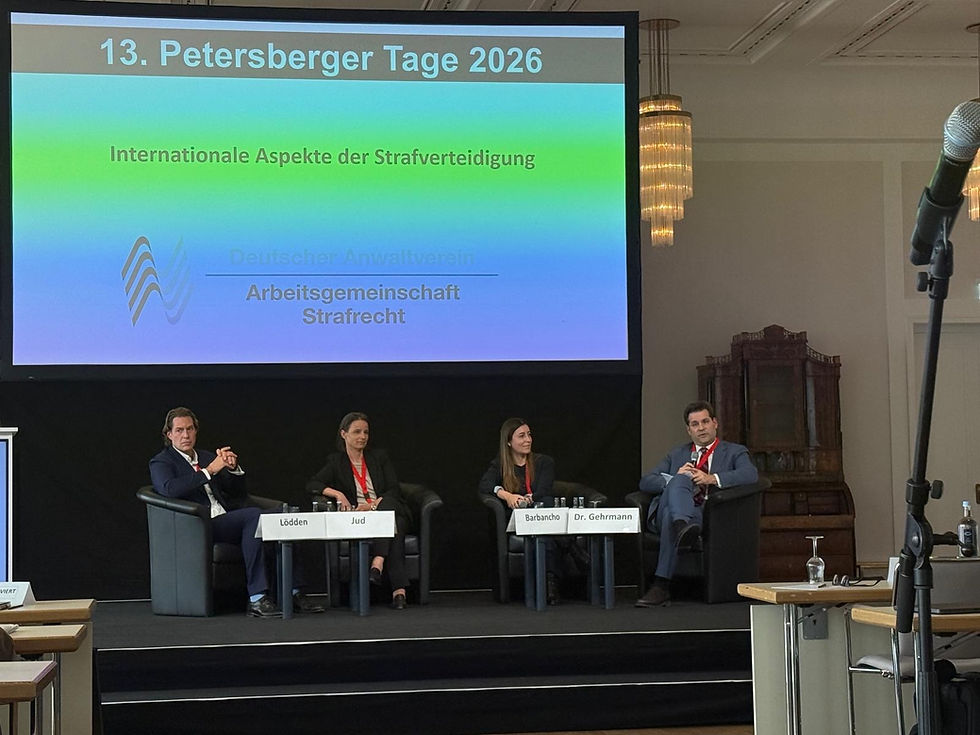
A Panel Report from Petersberger Tage 2026
The Petersberger Tage is one of the most respected annual gatherings in the German-speaking criminal defence community. Named after the Petersberg near Bonn, where the conference has traditionally been hosted, it brings together criminal defence practitioners, academics and judges from across the German-speaking world and beyond to exchange views on current developments in criminal procedure, substantive criminal law and legal policy. The conference is known for the high calibre of its speakers and the frankness of its discussions — qualities that were very much in evidence during this year’s edition.
This year, the programme once again reflected the growing importance of international criminal defence. Under that theme, the conference provided a platform for the Joint Defense Team (JDT) on 17 April 2026, in the form of a panel discussion rather than a traditional lecture format. This created a particularly dynamic setting for the exchange of practical experience, strategic reflection and cross-border perspectives. The panel was structured around three thematic presentations before opening into a broader discussion, and it drew considerable enthusiasm from the audience throughout.

The Origins of the Joint Defense Team
JDT Co-Founder Christian Lödden opened the session by tracing the origins of the network. He explained how the collaboration first took shape during the early days of the EncroChat prosecutions, a period that exposed the acute need for coordinated defence strategies across national borders. The EncroChat cases, involving encrypted communications allegedly harvested by law enforcement, were among the first to confront defence lawyers with the challenge of litigating complex technical and procedural issues simultaneously in multiple legal systems. It was precisely this challenge that gave rise to the idea of a structured — if deliberately informal — transnational network.
Cross-Border Defence Cooperation in Practice: The Swiss Experience
JDT member Dominique Jud then addressed the Swiss dimension of the association’s work, focusing on the concrete value that participation in the network has brought to criminal defence practice in Switzerland — and, equally, the value that Swiss experience has brought to colleagues in other European jurisdictions. She pointed in particular to a significant procedural success: the appellate ruling on the inadmissibility of SkyECC data in Swiss proceedings. This outcome, which has had far-reaching implications for the use of encrypted communications evidence, was facilitated in no small part by the cross-border exchange of legal arguments, procedural strategies and case intelligence that the association makes possible. The Swiss experience illustrated how membership of such a network can translate directly into favourable results for individual clients.
Forum Shopping, Jurisdiction and Strategic Early Action
JDT member Maria Barbancho concluded the initial presentations by addressing what is commonly described as forum shopping and the sentencing advantages that may arise from effective international cooperation. Her contribution focused on the strategic possibilities that emerge at an early stage of proceedings, particularly in relation to jurisdiction and venue, when defence teams have access to real-time intelligence from trusted colleagues in multiple countries. She emphasised that the ability to act swiftly and with well-informed tactical awareness — made possible precisely by the association’s structure — can be decisive in shaping outcomes for clients from the outset of a case.
Professional Secrecy, Liability and the Limits of Informality
Following these three presentations, the panel developed into a lively discussion among the panellists, moderated by Dr. Philipp Gehrman, who guided the conversation through a range of structural and ethical questions. Topics included the internal organisation of the association, the practical risks that membership may carry for day-to-day practice, and — perhaps most delicately — questions of professional secrecy in the context of sharing case files or sensitive information across borders. The issue of liability and remuneration in cross-border mandates also received close attention.
Throughout this discussion, all panellists were careful to reiterate a point they clearly regard as fundamental: JDT is not a law firm, nor does it function as one. It is a loose association of independent practitioners. Where formal mandates arise, they are concluded individually between the client and the relevant member, and governed by that member’s national rules of professional conduct. At the same time, it is precisely this informality that allows for a particularly fluid and candid exchange of strategic insights, early warnings and procedural tactics — an exchange that a more institutionalised structure might well inhibit.
A Critical Perspective on Mutual Trust in Europe
One of the key conclusions to emerge from the panel was that the trust built between international defence practitioners — and the deeper understanding of foreign criminal procedural systems that follows from it — also reveals something more fundamental: the principle of mutual trust, as applied in international cooperation, does not always justify itself in practice, even within Europe. The panel’s conclusion was therefore clear. For defence lawyers engaged in cross-border criminal proceedings, this is an area that demands sustained attention, practical knowledge and critical vigilance.
Why International Criminal Defence Networks Matter
The discussion at Petersberger Tage 2026 showed that international criminal defence is no longer a niche concern. In cases involving encrypted communication evidence, parallel investigations, cross-border disclosure issues and competing jurisdictions, defence strategies increasingly require international awareness and trusted professional cooperation. The Joint Defense Team’s contribution to the conference highlighted the practical importance of informal, high-level collaboration between independent criminal defence lawyers across Europe.


