
Digital Evidence Cannot Stand Above National Law: EncroChat, SkyECC and ANOM Before European Courts

Updated: Sep 1

Evidence gathered in one country must still be tested against the law of the country that uses it. Seven members of the Joint Defense Team set out that position in Dokaz ("Evidence"), a special programme broadcast by Televizija E in Montenegro on 27 August 2026, presented by Svetlana Đokić.
The subject was the wave of criminal proceedings built on data from the encrypted communication providers EncroChat, SkyECC and ANOM. Those operations were run by Joint Investigation Teams of several states, supported by Europol and Eurojust. Defence work has had to follow the same route. Our team exists because a case file that crosses four borders cannot be answered from one.
Taking part were Bojana Franović Kovačević (Montenegro), Christian Lödden (Germany), Justus Reisinger (Netherlands), Daniele Fiorino (Italy), Dominique Jud (Switzerland), Guillaume Martine (France) and Louis de Groote (Belgium).
Mutual trust is a principle of cooperation, not a bar to judicial review
Our co-founder Christian Lödden used ANOM to show what happens when trust takes the place of verification.

ANOM was marketed as an encrypted messaging service. Running it from United States territory was closed to the FBI under US law, so the system was operated from abroad, from servers in Lithuania. When the operation became public in June 2021, German authorities received large volumes of messages from the FBI, together with an assurance that judicial orders existed in an EU member state that was not named. The Lithuanian courts that issued those orders had not been told that the FBI was behind ANOM. (read more about the ANOM-Leaks here)
The Federal Court of Justice (BGH) (1 StR 54/24) has ruled that this principle applies until there is concrete evidence of irregularities. Such evidence is now available and was published by Christian Lödden in the ANOM leaks: Lithuanian investigating judges were deliberately withheld the crucial facts – namely, that ANOM was invented and operated by the FBI – and were thus misled. This very example demonstrates that the principle of mutual trust must not become a carte blanche for law enforcement agencies and must be critically scrutinised by the courts.
Switzerland: two courts that asked the questions
Dominique Jud, joining by video link, described how Swiss courts approached the same problem. Police of one state may not enter another state and search a device there without permission. French authorities never asked Switzerland for it.
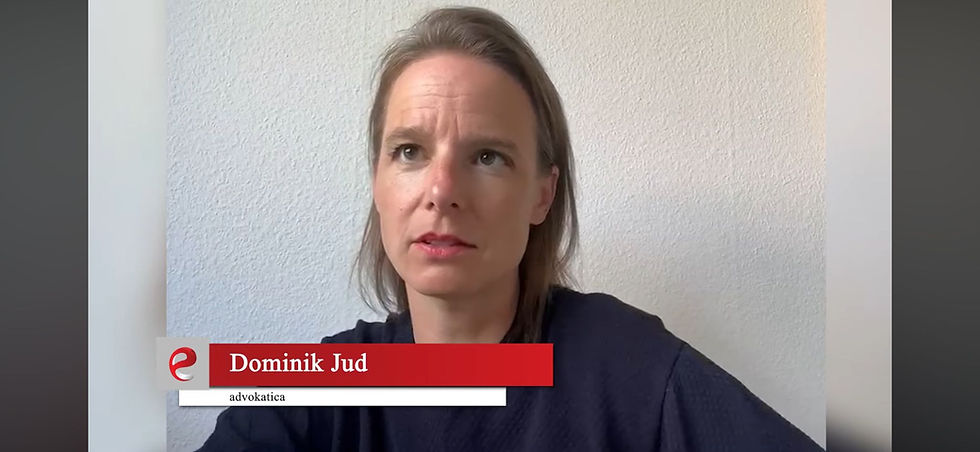
In August 2025 the Zurich High Court (SB240422-O/Z19/hb-nk) held that the SkyECC material could not be used. It was an unauthorised foreign operation, and at the moment the devices were accessed there was no concrete suspicion against the person later prosecuted. In October 2025 the Basel Court of Appeal (SB.2023.48) went further in a separate case, treating the monitoring of thousands of users in many countries over months as a breach of Swiss ordre public.
Disclosure mattered as much as sovereignty. The defence never saw raw data, only material processed through a Dutch forensic program which, on the Netherlands Forensic Institute's own account, decrypted around 74 % of the messages. The Basel proceedings are now before the Federal Supreme Court.
Montenegro: processed material, processed again
Bojana Franović Kovačević described a practice in which the international-trust formula has displaced the first question a court should ask, which is whether the evidence was obtained in accordance with national law. Only after that does the question of trusting the sending state arise.

Montenegrin case files contain processed material, and in her words also "the processing of the processing". Nobody in the courtroom knows who processed the data, when, on whose order, why, or by what method. Different prosecutors work from different versions of the same material.
She also pointed to the order in which the material reaches its audience. Chat records appeared in the media before they appeared in court, in an atmosphere shaped by political comment on organised-crime proceedings.
France, Italy, the Netherlands: the remedy that does not exist
Guillaume Martine recalled that the EncroChat cases began in 2020 and the SkyECC cases a year later, and that the servers of both services turned out to be in France. Because the operation was supervised by a French judge, only a French court can rule on its lawfulness, yet French law offers no remedy to a person prosecuted in another state. Dozens of applications were filed. After the Paris Court of Appeal refused them, the Cour de cassation referred the question to the Court of Justice of the European Union (C-625/25), and a decision is expected in the coming months (read more here). If the CJEU declines, the point goes to Strasbourg.

Daniele Fiorino set out the Italian version of the same gap. There is no appeal against a European Investigation Order in Italy; messages arrive from France and are used in evidence without judicial scrutiny of how they were produced. The defence is asking for access to the original data, since what France transmits is processed data. He added that the use of an encrypted application cannot in itself found a suspicion of crime: journalists, activists and politicians use encrypted phones for legitimate reasons.

Justus Reisinger framed the structural difficulty. Judges, prosecutors and defence lawyers are experts in law rather than in digital forensics, and the prosecution position often reduces to reliance on what another state supplied. Dutch courts have already acquitted sellers of encrypted phones where it could not be shown that the devices were sold exclusively to criminals (read more here). Where the stakes are highest, the rule of law has to demonstrate that it works.
Furthermore, Justus Reisinger discussed the cases pending at the level of European courts. In Strassbourg, at the European Court of Human Rights, there are pending cases on EncroChat (Silgir v. Germany I. & II. 27618/21 & 22234/2), SkyECC (Isha and Emmen v. Norway 7905/25 & 9417/25, read more here) as well as ANOM (Raal v. Estonia 14711725, read more here), regarding the lack of the possibility for defendants in criminal cases to actually challenge and contradict digital evidence (by a transparent chain of evidence and the availability of raw data). In Luxembourg, at the Court of Justice of the European Union, the lawfulness of operations like these is discussed, as well as the more procedural question: where should a defendant be able to execute an effective remedy when contesting the legality?

Digital evidence is not magic
Louis R. De Groote set out what the file itself looks like. A client may be prosecuted in country A on evidence collected in country B, which raises questions that are rarely answered clearly: how the evidence was collected, by which methods, why in that state, who had access to the data, what happened to it afterwards, and whether the defence is seeing all of it or only a selection.
Criminal files are no longer boxes of paper. They are data sets of thousands or millions of records, sometimes reviewed by defence lawyers on outdated computers in a court registry, and sometimes delivered as a Word document with no account of where the material originally came from, how it was extracted and what was done to it along the way.
He placed the European debate on chat control in the same frame. Investigative powers keep expanding in the name of security, and once private life is treated as inherently suspect, something has changed.

What the courts still have to decide
Cases concerning EncroChat, SkyECC and ANOM are pending before the European Court of Human Rights, all turning on the same Article 6 ECHR question: whether a defendant can genuinely contradict digital evidence without a transparent chain of evidence and without access to the raw data. Before the CJEU, the lawfulness of these operations is in issue alongside the procedural question of where an effective remedy can be exercised at all.
The point is not confined to the individual defendant. Compliance by law enforcement with law made through a democratic process is what separates a rule-of-law system from the alternative, and equality of arms is how a court reaches the truth about a case rather than the version it was handed.
Watch the full broadcast:
FAQ
Does the principle of mutual trust make foreign evidence untouchable?
No. It governs cooperation between states; where there are concrete indications that something went wrong, the receiving court still has to examine the evidence and where and how it was obtained.
Why does the defence ask for raw data instead of the transmitted files?
Because the transmitted files are processed material, and without the original data the defence cannot verify completeness, accuracy or integrity.
Where can a defendant challenge the lawfulness of the SkyECC interception?
That is the question referred by the French Cour de cassation to the CJEU: French law currently provides no remedy for people prosecuted outside France.
Is using an encrypted messenger evidence of criminal conduct?
No. Encrypted communication is used by journalists, activists, lawyers and politicians, and Dutch courts have acquitted sellers of encrypted phones on that basis.


